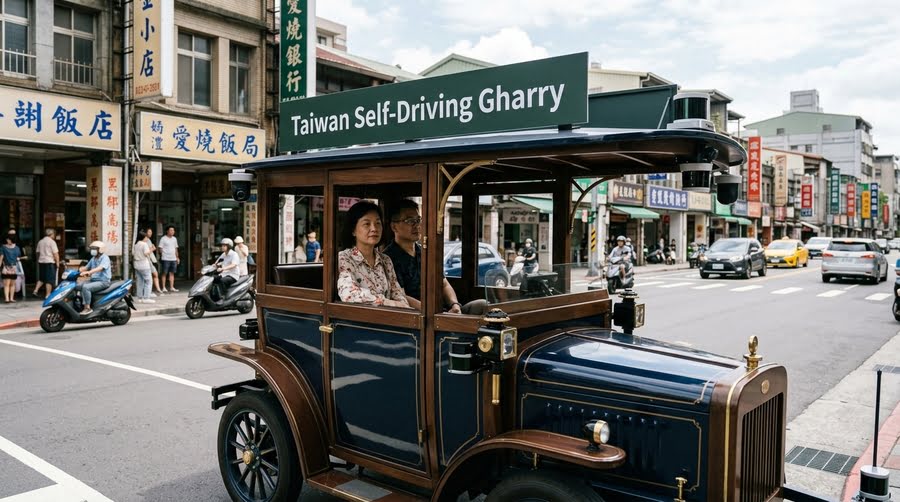
Taiwan Self-Driving Gharry

“Taiwan Self-Driving Gharry” refers to two distinct things: Taiwan’s autonomous vehicle testing program for self-driving buses operating in Taipei, and Gharry Car Rental—a Taiwan-based car rental company offering self-drive vehicles to foreign travelers. The term has generated confusion in search results because half the content treats it as a transportation technology trend while the other half points to a specific rental company. Both meanings matter for travelers planning trips to Taiwan.
Taiwan’s autonomous bus program runs electric self-driving buses equipped with lidar sensors, cameras, radars, and GPS navigation on designated routes in Taipei. Gharry Car Rental operates as a legitimate rental service offering self-drive cars, airport transfers, and chauffeur-driven services from locations including Taoyuan Airport. This guide covers both topics—the autonomous vehicle program’s current status and security considerations, and the practical details of renting a car through Gharry including pickup locations, costs, driving conditions, and licensing requirements for foreign travelers visiting Taiwan.
The Rise of Taiwan’s Self-Driving Gharry: Revolutionizing Transportation
Taiwan has introduced self-driving buses as part of its autonomous vehicle development in the transportation sector. These electric buses operate on designated routes in Taipei, carrying passengers during trial periods while collecting data to improve autonomous driving systems.
The self-driving bus program represents Taiwan’s investment in smart mobility infrastructure. The vehicles use a combination of HD maps, GNSS (Global Navigation Satellite System) receivers, lidar (Light Detection and Ranging) sensors, cameras, and radars to perceive their surroundings and make driving decisions. V2X (Vehicle-to-Everything) roadside units communicate real-time traffic light status to the bus and alert the system to potential collisions.
The buses operate on a Linux system that controls vehicle functions via CAN (Controller Area Network) bus. A GPU (Graphics Processing Unit) calculates acceleration and braking decisions in real time. Maximum speed is limited to 20 km/h (12.4 mph) during testing phases to ensure public safety.
Taiwan’s program joins similar initiatives in Hamburg (Germany), Kitakyushu (Japan), and Toronto (Canada)—all testing autonomous passenger buses on public roads. The technology demonstrates that self-driving public transit is moving from concept to reality, though full deployment during peak traffic hours remains a future milestone.
A Ride on Taiwan’s Self-Driving Bus
The self-driving bus runs a 12.3-kilometer (7.6-mile) route on a bus-exclusive lane during off-peak hours (12:30 AM to 2:30 AM). Two service personnel staff each bus: a driver tasked with overriding the system when problems occur, and an observer who monitors and records events during each ride.
What passengers experience:
- The bus accelerates smoothly and follows linear bus lanes without difficulty
- Braking is relatively smooth, with short actuator pulses applying gradual stopping force
- A large interior screen displays real-time sensor data including lidar point clouds and the preloaded HD map
- The ride takes approximately 15 minutes to complete the route
- Road bumps are more pronounced at the 20 km/h speed limit
During testing, occasional system issues require manual intervention. Communication glitches between the bus and traffic light infrastructure have caused the driver to temporarily take manual control. These issues are addressed through continuous software updates—problems reported during one run are typically fixed by the next day.
The trial period requires passengers to register via QR code scanning before boarding. When the system reaches full deployment, automated identification will replace manual scanning and the observer role will be removed.
Security insights
Self-driving buses introduce cybersecurity considerations that traditional vehicles do not face. The CAN bus component has potential for transmitting malicious messages. The Linux operating system requires protection against exploitation. Radio transmissions can be jammed, and wireless data transmissions are vulnerable to man-in-the-middle attacks.
3 security recommendations for autonomous vehicle systems:
- IDS/IPS (Intrusion Detection/Prevention Systems) for CAN bus that monitor vehicle networks for suspicious messages through deep packet inspection
- Defenses against lidar and radar sensor attacks that could feed false data to the autonomous driving model
- Operating system protections for the Linux and CUDA applications running the bus control systems
These security measures apply to all connected vehicles, not just Taiwan’s specific implementation. As autonomous driving technology expands globally, manufacturers build security into connected systems during development rather than retrofitting after deployment. Travelers interested in automotive technology innovations will find Taiwan’s program demonstrates where urban transit is heading within the next decade.
Gharry Car Rental
Gharry Car Rental is a legitimate Taiwan-based rental company offering self-drive vehicles, airport transfers, and chauffeur-driven services. The company’s English-language website—uncommon among smaller Taiwanese rental firms—explains why foreign travelers encounter the Gharry name frequently in search results.
Most people assume “gharry” describes a type of vehicle or transport category in Taiwan. That assumption is incorrect. Taiwan’s official tourism platforms do not list “gharry” as a recognized transport option. Gharry is a company name that search trends have amplified into apparent broader significance.
The company serves both locals and international travelers with a fleet covering multiple vehicle categories from compact cars to larger sedans and vans.
Locations for picking up a car
Gharry operates pickup locations in major cities across Taiwan, including:
- Taoyuan Airport (international arrivals)
- Taipei city center
- Kaohsiung
- Taichung
Airport pickup at Taoyuan Airport operates 24 hours, making the service accessible for late-night arrivals. This 24-hour availability is useful for travelers landing after public transit shuts down for the night.
Locations for returning a car
Return locations mirror pickup options. Gharry allows returns at different locations from pickup in some cases, though one-way fees apply. Major return points include Taoyuan Airport, Taipei, Kaohsiung, and Taichung stations.
Time for picking up a car
Pickup times at airport locations operate 24/7. City office locations typically follow business hours (8:00 AM to 8:00 PM local time). Confirm specific location hours when booking, as smaller offices may close earlier.
Time for returning a car
Return times follow the same schedule as pickup. Late returns incur additional charges calculated by the hour. Airport returns operate around the clock, making them the most flexible option for travelers with early morning flights.
Taoyuan Airport Shuttle Bus
Gharry provides shuttle service between Taoyuan Airport terminals and the company’s nearby vehicle lot. The shuttle eliminates the need to locate the rental office independently after landing. Staff meet arriving customers at designated points within the terminal.
This airport-adjacent setup streamlines the rental process for first-time visitors to Taiwan who are unfamiliar with local transportation options immediately after arriving.
Customer testimony
Foreign travelers who have used Gharry Car Rental report 3 consistent positive experiences: clear English communication during booking and pickup, straightforward documentation processing, and reliable vehicle condition upon delivery.
Negative feedback concentrates on post-rental toll charges appearing on credit cards 1-2 weeks after the trip ends. Taiwan’s electronic toll system means charges are calculated and billed after vehicle return—not during the drive. This surprises travelers who expect all costs to be settled at the return desk.
Some customers report that the vehicle selection at smaller pickup locations is more limited than what appears available online during booking. Confirming vehicle availability directly with the specific location before arriving prevents this issue.
Car models for self driving
Gharry offers self-drive vehicles across 4 categories for travelers holding valid International Driving Permits (IDP):
- Compact cars (1.6L engines) — suited for city driving and couples
- Mid-size sedans (2.0L engines) — comfortable for families and longer highway drives
- SUVs — appropriate for mountain routes like Hehuanshan and rural terrain
- Vans (7-9 seats) — group travel to destinations like Sun Moon Lake
Vehicle age in the fleet typically ranges from 1-4 years old. All vehicles include GPS navigation with English-language support, which is valuable for travelers unfamiliar with Taiwan’s road system.
Car models for chauffeur driving
Chauffeur-driven services use premium vehicles including:
- Business sedans for airport transfers and city transportation
- Luxury vans for group tours and corporate travel
- Multi-passenger vehicles for wedding and event services
Chauffeur services eliminate the need for an International Driving Permit entirely, making them accessible to travelers from countries without IDP reciprocity agreements with Taiwan. Pricing for chauffeur service runs approximately 2-3x the self-drive daily rate but includes fuel, tolls, parking, and a professional driver familiar with local roads.
Driving classroom
Gharry provides orientation for foreign renters unfamiliar with Taiwan’s driving conditions. The orientation covers:
- Right-hand traffic flow (Taiwan drives on the right side of the road)
- Scooter awareness and lane-sharing behavior
- Electronic toll system operation (no cash toll booths)
- Mountain road driving tips including hairpin turns and weather visibility
- Parking regulations and meter systems in urban areas
- Emergency contact procedures and roadside assistance
This orientation takes 10-15 minutes at pickup and reduces the learning curve for travelers whose home countries drive on the left side of the road. Visitors from the UK, Japan, Australia, and other left-driving countries benefit most from this briefing.
Business partners
Gharry maintains partnerships with Taiwan tourism operators including hotels, tour agencies, and transportation services. These partnerships provide integrated booking options where travelers reserve accommodations and rental vehicles through a single platform.
Hotel partnerships sometimes include discounted parking or reduced rental rates for guests. Tour agency partnerships offer pre-planned driving itineraries with recommended routes, restaurant stops, and scenic viewpoints along the way.
Places for picking up and returning a car
Complete location list:
- Taoyuan International Airport (24-hour operation)
- Taipei Songshan Airport
- Taipei Main Station area
- Taichung High-Speed Rail Station
- Kaohsiung International Airport
- Kaohsiung city center
- Hualien (eastern Taiwan)
One-way rentals between different cities are available with advance notice and surcharge. The most popular one-way route is Taoyuan Airport pickup with Kaohsiung return—allowing travelers to drive south along Taiwan’s western corridor and depart from the southern airport.
Online inquiry
Gharry accepts online bookings through the company’s English-language website. The booking process requires:
- Valid passport information
- International Driving Permit number (for self-drive)
- Credit card for deposit authorization
- Pickup/return location and date selection
- Vehicle category preference
Response time for online inquiries is typically 24-48 hours. Direct phone booking is available for travelers needing same-day reservations or last-minute changes to existing bookings.
Taiwan Rental Car Gharry: Complete Travel Guide

What “taiwan rental car gharry” actually refers to
“Taiwan rental car gharry” refers to Gharry Car Rental—a specific Taiwan-based company, not a vehicle category or transportation concept. Taiwan’s official tourism platforms do not list “gharry” as a recognized transport option. The term gained search visibility because Gharry’s English-language website ranks well for international queries about renting cars in Taiwan.
The confusion matters because travelers searching this phrase want practical information: whether Gharry is legitimate, whether foreigners can drive in Taiwan, and whether renting a car improves or complicates a Taiwan trip. The answer to all three is yes, with conditions.
How renting a car in Taiwan works in practice
Renting a car in Taiwan follows a familiar process with specific legal requirements that trip up first-time visitors.
Documentation requirements:
- Stays under 30 days: International Driving Permit (IDP) alongside home country license
- Stays over 30 days: IDP registered with a local Motor Vehicle Office, validity limited by permit duration and immigration status
- Credit card required for deposit hold
- Passport for identity verification
Taiwan’s Motor Vehicle Office enforces reciprocity rules that vary by nationality. Not every license is treated equally, even with an IDP. Travelers should confirm eligibility directly with the rental company before booking.
What happens at pickup
Arriving at the rental desk typically takes 15-20 minutes. Staff check documents, process payment authorization, and walk through vehicle condition documentation.
5 steps to complete before driving away:
- Photograph all existing vehicle damage (scratches, dents, dings) with timestamps
- Confirm the fuel policy (full-to-full is standard)
- Ask how electronic tolls are calculated and billed post-return
- Verify deposit amount and expected hold duration on credit card
- Test GPS navigation and confirm English-language voice guidance works
Taiwan uses an electronic toll system—no cash booths exist on freeways. Companies like Gharry calculate toll charges after vehicle return based on distance traveled, averaging NT$1.2 per kilometer (approximately $0.04 USD per km) on national highways. These charges appear on credit card statements 1-2 weeks after the trip.
When renting a car in Taiwan actually makes sense
Taiwan is not a country where travelers automatically need a car. The island’s public transport system is efficient, affordable, and widely used by locals who own cars.
Skip the rental when your itinerary focuses on:
- Taipei (metro, buses, and taxis cover everything)
- Kaohsiung (metro system and light rail)
- The west coast high-speed rail corridor (Taipei to Kaohsiung in 90 minutes)
- Taichung city center (bus system is free within certain zones)
Rent a car when your itinerary includes:
- Nantou county and Sun Moon Lake (limited bus schedules)
- Mountain regions like Hehuanshan (no public transit above certain elevations)
- Eastern Taiwan coastal drives (Yilan to Hualien scenic route)
- Early morning photography at remote locations
- Multi-stop itineraries outside major cities
The flexibility of a rental car shows its value outside urban areas. Couples, families, and photographers gain the most from self-drive rentals because they control timing, stops, and pace without bus schedules dictating the day.
A real-world example
A traveler lands at Taoyuan Airport at 11:00 PM. Trains into Taipei run until midnight, but onward connections to smaller towns like Yilan stop earlier. Renting a car directly from Gharry’s 24-hour airport desk allows immediate travel to Yilan (approximately 1 hour drive) without waiting for morning public transport.
The same traveler would struggle with Taipei traffic the following day—scooters, tight streets, and expensive parking make city driving frustrating. The benefit depends entirely on the next destination, not the rental itself.
Costs and hidden expenses travelers overlook
The daily rental price rarely tells the full story. Taiwan’s cost structure adds charges that accumulate beyond the base rate.
Complete cost breakdown for a typical 5-day rental:
- Base rental rate: NT$2,000-4,000/day ($65-$130 USD) depending on vehicle category
- Electronic freeway tolls: NT$1.2/km (~$0.04/km), averaging NT$200-500/day for highway driving
- Parking: NT$40-100/hour in Taipei, NT$20-40/hour in smaller cities
- Fuel: NT$30-32/liter for unleaded (~$1.00/liter, $3.80/gallon)
- Deposit hold: NT$10,000-30,000 ($325-$975 USD) blocked on credit card
- Insurance gap: Full car-body insurance for short-term rentals is not commonly available in Taiwan
The insurance situation surprises Western travelers who expect full coverage at the counter. Some rely on credit card travel insurance or policies from home, but coverage varies. Confirm what protection exists before signing the rental agreement.
Understanding hidden vehicle costs before committing helps travelers budget accurately rather than discovering surprise charges after the trip ends.
Driving conditions: easier than expected, until they’re not
Taiwan drives on the right side of the road (same as the United States, Canada, and mainland Europe). Left-hand-drive countries (UK, Japan, Australia) require adjustment.
Highway driving: Modern, well-maintained, clearly signed in both Chinese and English. Speed limits range from 100-110 km/h (62-68 mph). Most visitors find highway driving straightforward and comfortable for long-distance travel between cities.
Urban driving: Scooters dominate Taipei’s streets. Lane discipline is inconsistent. Narrow streets require constant mirror checking. Parking is scarce and expensive. Even experienced drivers feel overwhelmed during rush hours in major cities.
Mountain roads: Scenic but demanding. Narrow, winding, and weather-affected. Fog reduces visibility to near-zero on passes like Hehuanshan. Sharp turns without guardrails require careful speed management. Night driving on mountain roads is not recommended for unfamiliar drivers.
Driving age in Taiwan: 18 years old for cars, 16 for scooters. Foreign renters must be at least 20-21 depending on the rental company’s policy and the vehicle category.
The driving conditions are manageable for confident drivers who stay honest about their comfort level. A relaxed highway drive from Taipei to Taichung (160 km / 100 miles, approximately 2 hours) is very different from a steep mountain pass in rain at dusk. Smart car choices match the type of terrain planned for the trip—SUVs handle mountain roads better than compact city cars.
How Gharry compares to other rental options
Gharry stands out for international travelers based on 3 factors: English-language support, airport pickup availability, and straightforward online booking. These features make Gharry accessible in ways that smaller local companies are not.
Comparison against alternatives:
| Factor | Gharry | International Brands | Local Companies |
|---|---|---|---|
| English support | Full website + staff | Full | Limited/none |
| Airport pickup | 24-hour Taoyuan | Business hours | Varies |
| Precios | Mid-range | Premium (15-30% higher) | Budget (10-20% lower) |
| Vehicle age | 1-4 years | 1-3 years | 2-6 years |
| Insurance options | Basic | More comprehensive | Basic |
| Booking ease | Online English | Global platforms | Phone/Chinese sites |
Brand alone should not decide the choice. What matters more is whether the company fits the traveler’s itinerary, documentation situation, and expectations for service level. A well-reviewed local provider suits travelers comfortable handling Chinese-language communication or using translation tools.
Common mistakes travelers make
6 common mistakes when renting a car in Taiwan:
- Assuming a rental car is always needed — Many visitors pay for cars they barely use because their itinerary stays within cities served by excellent public transport
- Misunderstanding license requirements — Arriving with only a home-country license when an IDP is required leads to rental denial at the counter
- Underestimating total costs — Comparing only base rental rates without adding tolls, parking, fuel, and deposits inflates actual spending 40-60% above the advertised price
- Overestimating driving confidence — Urban scooter traffic and mountain switchbacks challenge even experienced drivers unfamiliar with Taiwan’s road culture
- Ignoring the insurance gap — Assuming full coverage is available at rental counters when Taiwan’s short-term rental market lacks comprehensive car-body insurance options
- Booking without confirming vehicle availability — Online listings don’t always reflect real-time inventory at specific pickup locations, especially during holiday periods
These mistakes apply whether renting through Gharry or any other Taiwan rental provider. The travelers who have the best rental experiences are those who research driving conditions before arriving and match their vehicle selection to planned routes.
Preguntas frecuentes
Is Gharry a real car rental company in Taiwan?
Yes, Gharry is a legitimate Taiwan-based car rental company offering self-drive vehicles, airport transfers, and chauffeur-driven services. The company operates physical pickup locations at Taoyuan Airport and multiple city offices across Taiwan. Gharry’s English-language website makes it visible to international travelers, which explains its prominence in search results compared to Chinese-only local competitors.
Do I need an International Driving Permit to rent a car in Taiwan?
Yes, tourists staying under 30 days need an International Driving Permit (IDP) alongside their home country license to legally drive in Taiwan. Reciprocity rules apply based on nationality—not every country’s IDP is accepted equally. Travelers staying longer than 30 days must register the IDP with a local Motor Vehicle Office. Confirm eligibility with both the rental company and Taiwan’s motor vehicle authority before booking.
Is renting a car in Taiwan better than using public transport?
Renting a car in Taiwan is better than public transport only for itineraries focused on rural areas, mountain regions, or multi-stop routes outside major cities. Taiwan’s public transport system—including high-speed rail, metro systems, and intercity buses—covers urban areas efficiently and affordably. Rent a car for destinations like Sun Moon Lake, Hehuanshan, or eastern coastal routes where bus schedules are limited and connections require planning.
How are tolls paid when driving in Taiwan?
Tolls in Taiwan are paid electronically through an automated system with no cash toll booths. Rental companies like Gharry calculate toll charges after vehicle return based on distance traveled on national highways, averaging NT$1.2 per kilometer ($0.04 USD/km). Charges appear on the renter’s credit card 1-2 weeks after the trip ends. Budget NT$200-500 per day ($6.50-$16 USD) for typical highway driving distances.
Is driving in Taiwan difficult for foreigners?
Driving in Taiwan ranges from easy to challenging depending on location. Highways are modern, well-signed in English and Chinese, and straightforward for experienced drivers. Urban areas (particularly Taipei) present challenges from dense scooter traffic, narrow streets, and limited parking. Mountain roads require careful speed management on sharp curves with limited visibility. Highway driving is accessible for most foreign drivers; city and mountain driving requires higher confidence and attention.
Can I rent a car directly from the airport?
Yes, companies including Gharry offer 24-hour car rental service at Taoyuan International Airport. Airport pickup eliminates the need to arrange separate transportation into the city before starting a road trip. Shuttle service runs between airport terminals and the rental lot. This option is particularly useful for travelers arriving on late-night flights when public transit options are limited or suspended.
Conclusión
“Taiwan Self-Driving Gharry” covers two distinct topics that share a keyword: Taiwan’s autonomous bus testing program demonstrating self-driving technology on Taipei streets, and Gharry Car Rental offering self-drive vehicles to foreign travelers exploring the island independently.
Taiwan’s autonomous bus program operates electric vehicles with lidar, radar, and camera systems on designated routes during off-peak hours. The technology works—passengers report smooth rides with occasional manual intervention for traffic light communication glitches. Full daytime deployment during peak traffic remains a future milestone.
Gharry Car Rental serves as a practical tool for travelers whose itineraries extend beyond Taiwan’s excellent public transit network. The company’s English support and airport availability make renting accessible, but the decision to rent depends on destination, not just availability. Travelers staying in cities save money and stress by using trains and buses. Travelers heading to mountains, coastlines, and rural regions gain meaningful flexibility from a rental car.
The right choice comes down to itinerary and comfort level—not what shows up in search results. Match the transportation method to the planned route, confirm documentation requirements before arrival, and budget for the full cost including tolls, parking, and fuel. That approach turns either a self-driving experience or a public transit trip into the right decision for the specific journey planned.