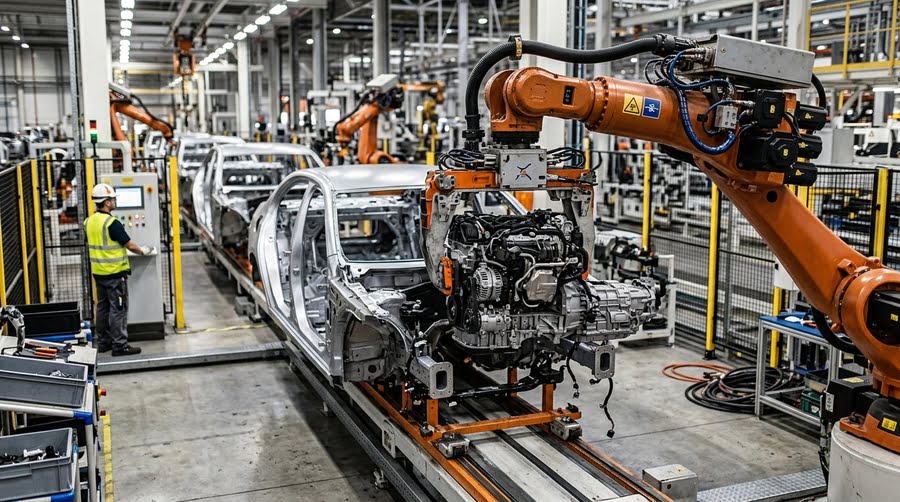
Engineering Precision: The Automotive Assembly Auxiliary Manipulator

In modern automotive manufacturing, cycle times are measured in seconds, and quality standards are absolute. The Automotive Assembly Auxiliary Manipulator is a highly specialized piece of ergonomic lifting equipment engineered to bridge the gap between heavy-duty payloads and delicate, micro-level positioning.
Unlike standard industrial hoists that only offer simple vertical lifting, an auxiliary manipulator functions as a “zero-gravity” extension of the operator. It is designed specifically for the complex, tight-clearance environment of a car assembly line, ensuring that heavy, awkward, or high-value components can be installed flawlessly by a single operator.
Core Technical Advantages
To meet the rigorous demands of automotive original equipment manufacturers (OEMs), these manipulators integrate several advanced technologies:
- Zero-Gravity Suspension: Utilizing precision pneumatic or electronic servo-balancing, the manipulator neutralizes the weight of the workpiece. A 60 kg car seat or a 100 kg transmission feels completely weightless, allowing operators to guide the part with minimal hand pressure.
- Rigid-Arm Anti-Sway Stability: Flexible cables allow loads to swing, which is unacceptable when inserting parts into a finished car body. The rigid, articulated arm structure resists torsion and prevents pendulum effects, ensuring the part remains perfectly stable and properly oriented.
- Cantilevered Reach: The articulated joints allow the arm to reach deep into enclosed spaces—such as reaching through a car door frame to install a dashboard or center console—without the structure of the crane interfering with the vehicle chassis.
- Custom Non-Standard Tooling: The end-effectors (grippers) are custom-engineered for specific automotive parts, featuring expanding mandrels, soft-touch pneumatic clamps, or vacuum suction arrays that guarantee a secure hold without scratching finished surfaces.
High-Impact Assembly Applications
Automotive auxiliary manipulators are highly modular and can be deployed across almost every station in the final assembly workshop:
- Interior Sub-Assembly: Installing heavy, bulky items like dashboards, panoramic sunroofs, and fully assembled automotive seats into the cabin with absolute precision.
- Powertrain and Chassis: Inserting drive shafts, aligning gearboxes, mounting heavy radiators, and precisely bolting front or rear axle subframes onto the chassis.
- Exterior and Glazing: Handling delicate glass parts like windshields (often paired with overhead KBK rail systems for multi-station reach), as well as heavy exterior components like doors and tire/wheel assemblies.
- New Energy Vehicles (NEVs): The smooth, tilt-free handling is critical for safely maneuvering and installing heavy, sensitive battery PACK modules into the underbody of electric vehicles.
The Business Impact: Ergonomics Meets ROI
Integrating auxiliary manipulators into an assembly line delivers an immediate, multi-faceted return on investment:
- Elimination of Operator Fatigue: By taking 100% of the payload weight, the system prevents musculoskeletal injuries and ensures cycle times remain consistent throughout an entire shift.
- Zero-Defect Assembly: Smooth, controlled handling prevents parts from colliding with the painted car body or cross-threading during insertion, drastically reducing scrap and rework costs.
- Optimized Workforce Utilization: Tasks that previously required two or three operators to manually lift and align can now be completed faster and safer by a single technician.