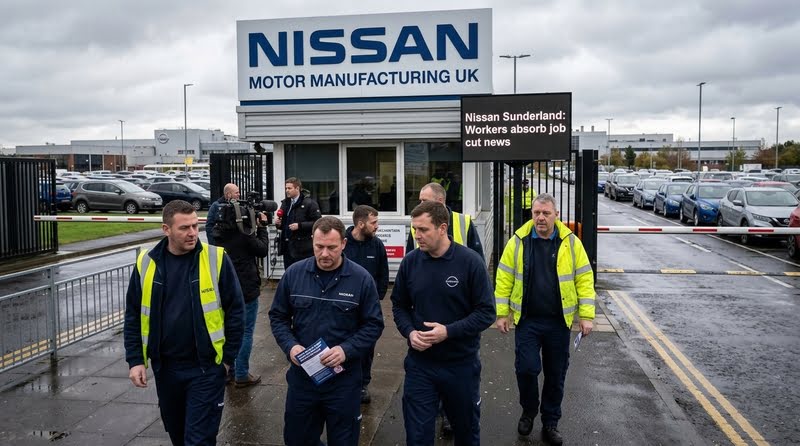
Nissan Sunderland Factory Job Losses

Nissan has announced the closure of one production line at its Sunderland plant and the cutting of 900 jobs across Europe, consolidating output from two lines to one at Nissan Motor Manufacturing UK (NMUK) while confirming that no manufacturing jobs at the Sunderland site will be lost directly through the line merger. The 900 European job cuts — approximately 10% of Nissan’s 9,300-strong European workforce — target white-collar office roles and warehouse staff across the UK, France, and Spain, with a small number of UK-based office positions included in that total.
The changes form part of Nissan’s RE:Nissan restructuring programme, launched in 2025 under Chief Executive Ivan Espinosa, which targets a 15% reduction in Nissan’s global workforce across 20,000 positions and a reduction of Nissan’s manufacturing footprint from 17 plants to 10 by 2027.
This article covers 3 core areas of the Nissan Sunderland factory job losses story:
- The Sunderland production line closure and Europe-wide restructuring — what Nissan confirmed, which roles are affected, and what the single-line operation means for the plant’s future
- Broader industry context — the electric vehicle (EV) transition pressures, competitor activity from BYD, BMW, and Honda, and motor finance regulatory developments that frame Nissan’s decision
- Stakeholder and partnership developments — the ex-Nissan staff pension scheme concerns and ongoing talks with Chinese automaker Chery about using the freed production line
Nissan Restructuring: Sunderland Production Line Closure and European Job Cuts
Nissan confirmed on 5–6 May 2026 that Nissan Motor Manufacturing UK will consolidate production from 2 lines to 1 at its Sunderland plant, merging the lines that currently produce the Leaf, Juke, and Qashqai models. The company stated no Sunderland production jobs will be lost through this specific change.
The broader European restructuring running alongside the Sunderland consolidation targets 900 positions — around 10% of Nissan’s European headcount — through proposals including the partial closure of Nissan’s Barcelona warehouse and a shift to an importer-led distribution model for Nordic countries including Sweden, Norway, and Denmark.
A Nissan spokesperson confirmed the scope of the changes in a statement published by the BBC and Press Association (PA): “Under the Re:Nissan recovery plan, we have been taking decisive actions to enhance performance and create a leaner, more resilient business that adapts quickly to market changes. As part of this approach, today we have opened discussions with our European employees with a view to simplifying our structures, reducing complexity, and ensuring we operate in a sustainable and profitable way.”
Overview of Nissan’s Europe-wide Restructuring
Closure of Sunderland Production Line and Reduction to Single-Line Operations
Nissan’s Sunderland plant currently operates at approximately 50% of its production capacity, according to reporting by Automotive World’s Stewart Burnett. The site employs around 6,000 workers and produces 3 models — the Leaf, Juke, and Qashqai — but the 2 production lines running those vehicles have not been operating at full volume for an extended period.
Consolidating output onto a single line addresses the efficiency gap directly. Running 1 line at higher utilisation costs less to operate per unit produced than running 2 lines at low volume. The freed second line becomes available for a third-party manufacturer to use, which creates a route for Nissan to share the fixed costs of operating the UK’s largest car plant without reducing its own 6,000-strong Sunderland workforce.
The next-generation Leaf entered production at Sunderland in December 2025, supported by a £450 million investment in upgraded factory technology and engineering training. The Leaf is positioned as a sub-$30,000 (approximately £24,000) EV entry point for US and European consumers. A Juke EV is expected to follow in 2027. Both models are the Sunderland plant’s most consequential near-term products, and their sales performance will determine whether single-line operations represent a temporary transitional arrangement or a longer-term production ceiling for the site.
UK registrations of Nissan vehicles fell 13% in the first 4 months of 2026, with Nissan’s UK market share dropping from 4.7% to 3.7% year-on-year despite the new Leaf’s launch. EU sales declined 8.3% during the first quarter of 2026, underlining the urgency behind the RE:Nissan plan’s European cost reduction measures.
Impact on European Workforce with 900 Job Cuts
The 900 European job cuts break down as follows across the confirmed locations:
- Spain — approximately 500 of the 900 cuts affect Spanish workers, primarily through the partial closure of the Barcelona warehouse
- UK — a small number of UK-based office roles are included in the 900 total; no Sunderland production jobs are part of this figure
- France — office and administrative roles affected, with exact figures not specified by Nissan
- Nordic markets — the shift to an importer model eliminates the need for Nissan’s own distribution workforce in those countries
Miguel Ruiz, leader of Spanish union USOC (Unión Sindical Obrera de Cataluña), described the cuts to Reuters as “a new disappointment” and stated that the final figure for Spain would be negotiated downward with unions in the coming weeks. Local unions across Nissan’s European operations have pushed back on the restructuring proposals since the RE:Nissan plan was announced.
Nissan did not specify which exact roles would be impacted across each European location beyond the Barcelona warehouse partial closure and the Nordic importer model transition. The company confirmed discussions with European employees had formally opened as of 5 May 2026.
The 900 European cuts sit within the larger RE:Nissan target of 20,000 global job reductions and the factory closure programme that takes Nissan’s worldwide manufacturing footprint from 17 plants to 10 by 2027.
Corporate Strategy: Assessing Future Opportunities for Plant Utilisation
Nissan’s stated goal for the Sunderland single-line consolidation is to “secure full plant utilisation” — a phrase used directly in the company’s official spokesperson statement and confirmed across BBC, PA Media, and Automotive World reporting.
Nissan told the Financial Times (FT) — which broke the story — that the company was exploring “opportunities with third parties to maximise plant utilisation.” The FT had previously reported that Chery and other Chinese manufacturers had been in active discussions about using the idle Sunderland line to build their own vehicles under a contract manufacturing arrangement.
This approach would allow Nissan to generate revenue from the second line’s capacity without committing to additional Nissan-branded production volume that current European demand does not support. It also protects the Sunderland workforce from immediate redundancy by keeping the facility economically viable at a higher operational utilisation rate.
Nissan will publish full-year financial results on 13 May 2026. The company’s revised forecast includes a JP¥50 billion (approximately £270 million / $340 million) operating profit for the year ended March 2026, though this figure rests substantially on one-time benefits from US emissions regulation changes and favourable foreign exchange movements rather than underlying sales improvement.
Broader Industry Context and Market Trends
Automotive Sector Challenges: EV Incentives, Parts Supply, and Demand Fluctuations
The Nissan Sunderland job losses and European restructuring reflect pressures that extend across the entire automotive manufacturing sector in the UK and Europe in 2025–2026.
4 primary market pressures driving automotive manufacturing restructuring in this period:
- EV demand shortfall — Consumer uptake of electric vehicles in Europe has grown more slowly than manufacturer investment cycles anticipated, leaving EV-focused plants including Sunderland operating below capacity on new electric model lines
- Parts supply chain disruption — Global component supply chains remain disrupted following post-pandemic logistics instability and geopolitical sourcing shifts, increasing per-unit production costs
- US tariff impact — US President Donald Trump’s trade tariff policies have added cost pressure to manufacturers exporting to the US market, directly affecting Nissan’s revised financial forecasts and contributing to the RE:Nissan plan’s urgency
- Emissions regulation compliance costs — Changes to US emissions regulations created one-time financial benefits reflected in Nissan’s JP¥50 billion operating profit forecast, but the underlying compliance cost structure for European manufacturers remains high
The Sunderland plant’s status as a flagship EV hub — producing the next-generation Leaf from December 2025 — has protected it from the full wave of factory closures hitting Nissan’s global network. But operating at 50% capacity is not financially sustainable without either significantly increasing Nissan production volume or bringing in a third-party manufacturing partner to fill the idle line.
Competitor Activity: BYD, BMW, and Honda Market Developments
Nissan’s restructuring at Sunderland occurs against a backdrop of significant competitor movement in the UK and European automotive market.
BYD has expanded its UK and European sales presence aggressively through 2024 and 2025, offering competitively priced electric vehicles that directly compete with the Nissan Leaf’s target market segment. BYD’s growth has compressed the available market share for incumbent EV manufacturers including Nissan, contributing to the 13% UK registration decline and 3.7% market share figure recorded in early 2026.
Chery — the Chinese automaker in talks with Nissan about using the freed Sunderland production line — entered the UK market in late 2024 through its Jaecoo and Omoda brands and has seen rapid sales growth since launch. Chery is already preparing to assemble vehicles at a former Nissan facility in Barcelona, making the Sunderland discussions a natural extension of Chery’s European manufacturing strategy. Chery’s UK head, Victor Zhang, previously told the BBC that Chery was evaluating whether to establish a manufacturing base in the UK, and the freed Sunderland line represents the most immediately available contract manufacturing option for that purpose.
Jaguar Land Rover (JLR) has also been connected to discussions about using Nissan’s surplus capacity, according to Automotive World reporting, though no formal arrangement has been confirmed between JLR and Nissan.
The broader Chinese automaker expansion into European manufacturing — with multiple brands evaluating UK and continental production options — creates both competitive pressure on existing manufacturers and a potential partnership market for plants like Sunderland that have surplus capacity.
Developments in Motor Finance and Regulatory Challenges
The UK automotive sector faces a separate but concurrent regulatory challenge through the ongoing motor finance mis-selling investigation and Financial Conduct Authority (FCA) review of discretionary commission arrangements. This investigation affects the consumer financing environment for new car purchases across all UK manufacturers and dealer networks, including Nissan’s UK retail operations.
Tighter consumer credit conditions and higher borrowing costs reduce the pool of buyers who can finance new vehicle purchases, which compounds the demand-side pressure on Nissan’s UK registration figures. The 13% UK registration decline in early 2026 reflects both Nissan-specific market share issues and broader consumer spending constraints affecting the full-size sedan and crossover market segments where Nissan competes.
Emissions regulations in both the UK and EU continue to require manufacturers to hit fleet-average CO₂ targets, with penalties for non-compliance. Nissan’s EV-forward positioning through the new Leaf and forthcoming Juke EV supports regulatory compliance, but the commercial viability of those products depends on achieving sales volumes that current European demand has not yet delivered.
Internal and Stakeholder Relations
Ex-Nissan Staff Pension Scheme Concerns
Former Nissan employees have raised concerns about the pension scheme arrangements affecting ex-staff from the Sunderland plant, calling for a rethink on how the scheme is structured and managed. The BBC reported these concerns as a separate but related development alongside the production line closure announcement, with ex-Nissan staff groups pressing for changes to the pension terms covering former Sunderland workers.
The specific nature of the pension scheme concerns — whether they relate to scheme funding levels, benefit calculation changes, or administrative arrangements — was not detailed in the confirmed BBC reporting at the time of publication. The concerns represent a distinct issue from the current 900-job European restructuring, as they affect former employees rather than the active 6,000-strong Sunderland workforce.
The timing of the pension scheme concerns emerging alongside the production line closure announcement reflects broader uncertainty among both current and former Nissan Sunderland staff about the plant’s long-term trajectory and employment security. The North East and Cumbria region has a substantial community of current and former Nissan workers, and the Sunderland plant has been a cornerstone of North East England’s manufacturing employment base since Nissan opened the facility in 1986.
Strategic Partnerships and Talks with Chery
Nissan has held talks with Chery — the Chinese automaker that owns the Jaecoo and Omoda brands — about using the freed Sunderland production line, according to BBC reporting by Jonny Manning and Theo Leggett and confirmed through Automotive World’s sourcing from the Financial Times.
Chery is the leading candidate among several companies Nissan has approached about filling the idle line’s capacity. The arrangement under discussion would allow Chery to assemble vehicles at Sunderland under a contract manufacturing model, where Chery provides the vehicle design and brand while Nissan provides the production facility, workforce, and manufacturing expertise.
This model mirrors the arrangement Chery is already pursuing at the former Nissan plant in Barcelona, where Chery is preparing to begin vehicle assembly using infrastructure previously operated by Nissan. The Sunderland discussions represent a potential expansion of that same approach to the UK.
Chery was unavailable for comment on the Sunderland talks at the time of publication, but Chery’s UK head Victor Zhang previously confirmed to the BBC that Chery was actively evaluating UK manufacturing options. Nissan declined to confirm the Chery discussions directly, telling the Financial Times only that Nissan was exploring “opportunities with third parties to maximise plant utilisation.”
The commercial logic is straightforward for both parties. Nissan gains a revenue-generating use for a line it cannot currently fill with its own production volume, reducing the per-unit fixed cost burden on Sunderland’s operations. Chery gains access to an established, fully equipped UK manufacturing facility with a trained workforce of 6,000, avoiding the capital cost and time required to build a new plant from scratch. Victor Zhang’s previous BBC statement that Chery was evaluating UK manufacturing options signals that Chery recognises the political and commercial value of UK-assembled vehicles in the current regulatory environment.
Whether Chery formalises the arrangement will determine much of what happens next at Sunderland. A confirmed Chery partnership would stabilise the plant’s operational future, protect the existing workforce from further restructuring pressure, and establish Sunderland as a dual-brand production hub for the first time in its history. Without a confirmed third-party partner, the single-line operation leaves the plant’s long-term capacity utilisation dependent entirely on Nissan’s own European sales recovery — a trajectory that the 2026 registration figures have not yet supported.
Nissan’s full-year financial results, due 13 May 2026, are expected to provide further detail on the RE:Nissan plan’s progress and the company’s revised projections for European operations including the Sunderland site.
Reporting sources: BBC News (Jonny Manning, Theo Leggett), Automotive World (Stewart Burnett), PA Media (Anna Wise, Press Association), Financial Times, Reuters, Card Dealer Magazine. Follow BBC Sunderland on X, Facebook, Nextdoor, and Instagram for ongoing Sunderland plant updates.