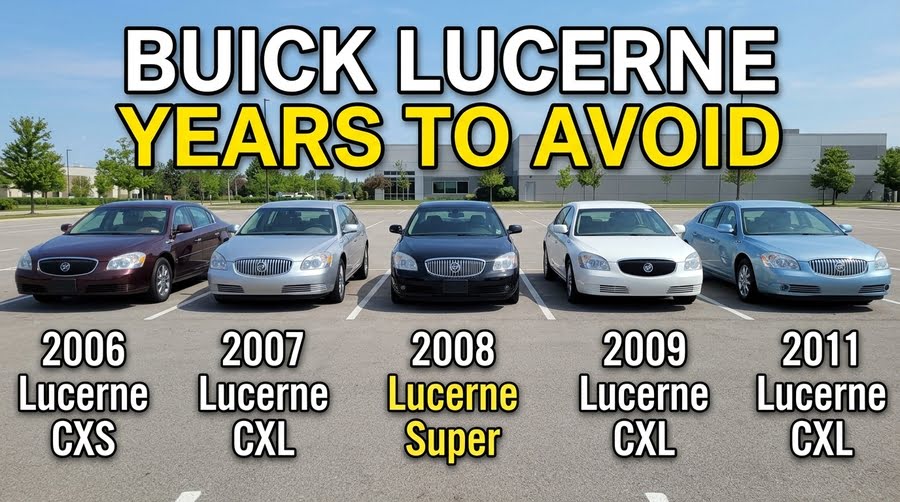
Buick Lucerne Years to Avoid

The Buick Lucerne years to avoid are 2006, 2007, 2008, and 2011, with the 2006 and 2007 model years carrying the highest risk for used car buyers due to initial launch quality problems, widespread electrical system failures, and engine reliability issues documented across 938 total National Highway Traffic Safety Administration (NHTSA) complaints for the entire 2006–2011 production run.
The Buick Lucerne is a front-wheel-drive (FWD) full-size sedan produced by General Motors (GM) from 2006 through 2011. The Lucerne replaced the Buick LeSabre and Buick Park Avenue and was offered with multiple engine options including the 3.8L V6, a 3.9L V6 in two variants, and the 4.6L Northstar V8. Not every model year delivers the same ownership experience — some years generate far more complaints, higher repair costs, and greater safety risk than others.
This guide covers 4 core areas for used Buick Lucerne buyers:
- Which Buick Lucerne years to avoid and which years are worth buying — with specific year-by-year analysis
- Common reliability issues — engine problems by variant, transmission failures, electrical system faults, and steering and suspension defects
- Safety ratings and official recalls — NHTSA crash test data and all 6 active recall campaigns
- Pre-purchase tips, alternatives, and frequently asked questions
Buick Lucerne (2006–2011): Comprehensive Reliability and Buying Guide
The Buick Lucerne ran for a single generation spanning 6 model years from 2006 to 2011. General Motors positioned the Lucerne as a large, comfortable sedan targeting buyers who prioritized a quiet ride, a roomy interior, and a smooth highway driving experience over sporty handling or fuel efficiency.
The Lucerne offered 4 primary engine variants across its production run:
- LZ9 — 3.9L 6-cylinder gasoline engine
- LD8 — 4.6L 8-cylinder Northstar V8 gasoline engine
- LGD — 3.9L 6-cylinder Flexible Fuel Vehicle (FFV) engine
- L26 — 3.8L 6-cylinder gasoline engine
All variants paired with a 4-speed automatic transmission. The 4.6L V8 was available exclusively on the CXS trim and included standard stability control — a safety feature that was only optional on lower V6 trims. Consumer Reports noted that the Lucerne had a tendency to fishtail at handling limits without stability control, which reduced confidence during emergency maneuvers.
Used Buick Lucerne pricing ranges from approximately $3,025 to $6,525 depending on model year, trim, mileage, and condition, based on Consumer Reports retail price data.
Buick Lucerne Years to Avoid and Better Options
The Worst Buick Lucerne Years to Avoid
The 4 worst Buick Lucerne years to avoid are 2006, 2007, 2008, and 2011. These model years generate the highest complaint volumes, the most expensive repair bills, and the greatest number of active safety recall campaigns relative to the 6-year production run.
| Model Year | Primary Problems | Risk Level |
|---|---|---|
| 2006 | Engine cooling, electrical faults, launch defects | High |
| 2007 | Engine stalling, transmission trouble, harsh shifting | High |
| 2008 | Electrical system failures, ignition faults, steering issues | High |
| 2011 | Engine and transmission failures, post-warranty repair costs | Moderate-High |
2006 Buick Lucerne
The 2006 Buick Lucerne is the first model year of the production run and carries the highest rate of initial launch quality problems. First-year vehicles across any nameplate carry elevated defect risk, and the 2006 Lucerne follows this pattern directly. Engine cooling system faults, electrical system wiring defects, and design flaws that General Motors had not yet corrected from the development phase all appear in 2006 complaints. Owners of 2006 models reported costly repairs early in the vehicle’s life — often before the car reached moderate mileage. The 2006 model year also falls under the most recall campaigns in the Lucerne lineup, including the heated washer fluid system fire risk recall (08V441000) and the ignition switch recall (14V355000) that affects vehicles from 2006 through 2011. A sunroof safety standard compliance failure recall (07V468000) and a power steering hose crimping defect recall (06V105000) further compound the 2006 model’s risk profile.
2007 Buick Lucerne
The 2007 Buick Lucerne continued the reliability problems established in the 2006 model year without meaningful corrections to the core powertrain and electrical issues. Engine stalling at moderate mileage is a documented complaint pattern for 2007 Lucernes, and transmission trouble — including harsh shifting and hesitation during acceleration — generated significant owner frustration. Repair costs for 2007 models exceeded what most owners expected for a vehicle in this price range and age bracket. The 2007 Lucerne falls under the ignition switch recall (14V355000) and the heated washer fluid system recall campaigns, adding unresolved safety exposure on top of the mechanical reliability concerns.
2008 Buick Lucerne
The 2008 Buick Lucerne is the model year most associated with recurring electrical system failures. Wiring malfunctions, ignition system failures, and warning light faults are the dominant complaint categories for this year. Multiple owners reported steering and suspension problems that made the vehicle feel unsafe during highway driving. The 2008 model falls directly under the large heated washer fluid system recall (08V441000), which affected 857,735 vehicles across multiple GM brands and cited a short circuit risk on the printed circuit board (PCB) for the washer fluid heater. Combined, the electrical failures and active recall exposure make the 2008 Lucerne one of the highest-risk years in the lineup.
2011 Buick Lucerne
The 2011 Buick Lucerne was the final production year for the model, and buyers who expected a refined, corrected final-year vehicle found continued engine and transmission reliability problems. Post-warranty repair cost traps are a specific concern for 2011 Lucernes in today’s used car market — the vehicles are now old enough to be well outside any factory powertrain coverage, meaning engine and transmission repair costs fall entirely on the buyer. The 2011 model falls under the ignition switch recall (14V355000) and the starter/alternator cable contact recall (10V553000), both of which remain serious electrical system safety concerns.
Best Buick Lucerne Years Worth Buying
The 2 best Buick Lucerne years worth buying are 2009 and 2010, which show lower complaint rates, fewer active safety concerns, and documented improvements to the reliability issues that defined the 2006–2008 production window.
2009 Buick Lucerne
The 2009 Buick Lucerne addressed many of the early production defects that plagued the 2006 through 2008 models. Electrical complaint rates dropped relative to the earlier years, engine performance complaints decreased, and owner satisfaction scores improved. The 2009 model still falls under the ignition switch recall (14V355000) and the heated washer fluid system recall (10V240000), so VIN verification remains necessary before purchase. With a confirmed clean recall history and documented service records, the 2009 Lucerne represents the first year in the production run where ownership satisfaction consistently outpaced frustration in owner reports.
2010 Buick Lucerne
The 2010 Buick Lucerne is widely regarded as the most reliable year in the Lucerne lineup. General Motors had addressed the most significant mechanical and electrical design flaws by this point in the production cycle, and the 2010 model year shows the lowest rate of major engine and transmission complaints across the 2006–2011 span. Consumer Reports data and Kelley Blue Book reliability assessments both reflect the 2010 Lucerne’s improved standing relative to earlier years. The 2010 model falls under the starter/alternator cable contact recall (10V553000) for V8-equipped vehicles, so buyers should confirm recall completion status through the NHTSA VIN lookup tool before purchase. A 2010 Lucerne with documented maintenance history, confirmed recall completion, and a pre-purchase mechanical inspection represents the strongest used car value in the Lucerne lineup.
Common Reliability Issues
The Buick Lucerne has 938 total complaints filed with NHTSA across the 2006–2011 production run. The 5 most frequently reported problem categories at the vehicle level are:
- Electrical system issues — 364 complaints
- Fuel system issues — 117 complaints
- Engine issues — 94 complaints
- Body/trim issues — 87 complaints
- Safety systems issues — 67 complaints
Electrical system failures represent the single largest complaint category by a wide margin, accounting for nearly 39% of all NHTSA complaints filed for the 2006–2011 Buick Lucerne.
Engine Reliability and Known Issues
The Buick Lucerne was offered with 4 primary engine variants, and all 4 carry an “Avoid” rating based on NHTSA complaint density data from TheWeeklyDriver.com. The complaint volumes and specific failure patterns differ significantly between variants.
LZ9 Engine Analysis
The LZ9 is a 3.9L 6-cylinder gasoline engine with 36 total complaints and a complaint rate of 18.0 per year, carrying an Avoid rating of 1.7 out of 5.0. The LZ9 has 3 associated fire reports on record.
LZ9 complaint breakdown by category:
- Electrical system: 21 complaints
- Fuel system: 10 complaints
- Steering: 5 complaints
- Body: 4 complaints
- Engine: 3 complaints
The LZ9’s dominant complaint category is electrical rather than engine-mechanical, meaning the engine hardware itself generates relatively few direct complaints compared to the electrical system components associated with it. The LZ9 engine is shared across multiple General Motors platforms, including the Chevrolet Tahoe (2007–2014), Chevrolet Impala (2006–2016), Chevrolet Suburban (2007–2014), and GMC Sierra 1500 (2007–2013), among others.
LD8 Engine Analysis
The LD8 is the 4.6L 8-cylinder Northstar V8 engine with 117 total complaints and a complaint rate of 38.0 per year, carrying an Avoid rating of 1.3 out of 5.0. The LD8 has 4 associated fire reports on record.
LD8 complaint breakdown by category:
- Electrical system: 38 complaints
- Body/trim: 21 complaints
- Engine: 18 complaints
- Steering: 13 complaints
- Safety systems: 11 complaints
The Northstar V8 is the highest-displacement engine option in the Lucerne lineup and carries the second-highest complaint volume among the 4 primary variants. Engine issues account for 18 complaints — the highest raw engine complaint count of any variant — and the LD8 generates the most steering-related complaints at 13. The Northstar V8 engine is shared with the Cadillac DTS (2006–2011), Cadillac DeVille (2000–2005), Cadillac CTS (2003–2007, 2008–2013), and Cadillac Seville (2000–2004). Head gasket failure is a known long-term concern with the Northstar V8 architecture across all GM applications, and Buick Lucerne owners of V8 models report this issue as a significant post-warranty repair cost trap when purchasing used examples.
LGD Engine Analysis
The LGD is a 3.9L 6-cylinder Flexible Fuel Vehicle (FFV) engine with 158 total complaints and a complaint rate of 52.7 per year, carrying an Avoid rating of 1.1 out of 5.0. The LGD has 19 associated fire reports — the highest fire report count among the 4 primary variants.
LGD complaint breakdown by category:
- Electrical system: 85 complaints
- Fuel system: 47 complaints
- Engine: 14 complaints
- Other: 12 complaints
- Interior: 9 complaints
The LGD carries the most serious complaint profile of the V6 variants. Electrical system issues account for 85 complaints with a typical onset between 75,000 and 129,000 miles (120,750–207,600 km) and an estimated repair cost of $686–$1,000 (£540–£790) based on 6 reported repair cost submissions. Fuel system issues account for 47 complaints with a typical onset between 77,700 and 117,000 miles (125,000–188,300 km). The 19 fire reports associated with the LGD are a significant concern — no other Lucerne engine variant approaches this number. The LGD is shared with the Buick LaCrosse (2005–2009, 2010–2019), Chevrolet Impala (2006–2016), and several other GM platforms.
L26 Engine Analysis
The L26 is the 3.8L 6-cylinder gasoline engine with 498 total complaints and a complaint rate of 99.6 per year, carrying an Avoid rating of 1.0 out of 5.0. The L26 has 22 associated fire reports and 1 reported fatality — the only fatality in the Lucerne engine complaint database.
L26 complaint breakdown by category:
- Electrical system: 217 complaints
- Body/trim: 66 complaints
- Engine: 61 complaints
- Fuel system: 59 complaints
- Safety systems: 55 complaints
The L26 3.8L V6 generates by far the highest complaint volume of any engine variant in the Lucerne lineup, accounting for more than half of all 938 total vehicle-level complaints. The 217 electrical system complaints carry a typical onset between 31,435 and 89,250 miles (50,575–143,650 km) with estimated repair costs of $325–$1,120 (£255–£880) based on 15 reported submissions. Engine issues show a typical onset between 46,500 and 84,000 miles (74,850–135,200 km). Body and trim issues show a typical onset between 53,750 and 79,869 miles (86,500–128,550 km) with repair costs of $250–$1,425 (£197–£1,120).
The L26 3.8L V6 is the base engine most commonly associated with Buick Lucerne reliability complaints in owner forums and on CarComplaints.com. Despite being marketed as the entry-level powerplant, the L26 generates more complaints than all other Lucerne engine variants combined. The L26 is shared with the Buick LeSabre (2000–2005), Buick Century (2000–2005), Buick LaCrosse (2005–2009), Chevrolet Impala (2000–2005, 2006–2016), Chevrolet Malibu (2004–2007), and several other GM platforms.
Engine reliability comparison:
| Engine | Displacement | Complaints | Rate/Year | Fire Reports | Rating |
|---|---|---|---|---|---|
| LZ9 | 3.9L V6 | 36 | 18.0 | 3 | 1.7 (Avoid) |
| LD8 | 4.6L V8 | 117 | 38.0 | 4 | 1.3 (Avoid) |
| LGD | 3.9L V6 FFV | 158 | 52.7 | 19 | 1.1 (Avoid) |
| L26 | 3.8L V6 | 498 | 99.6 | 22 | 1.0 (Avoid) |
Transmission Issues
The Buick Lucerne uses a 4-speed automatic transmission across all engine variants. Transmission failure is one of the most consistently reported and most expensive problems in Lucerne ownership.
3 primary transmission failure symptoms reported by Lucerne owners:
- Harsh shifting — The transmission shifts abruptly between gears, particularly during acceleration from a stop or during downshifting on deceleration. Harsh shifting is most frequently reported on 2007 and 2008 models and often appears before 100,000 miles (160,900 km)
- Shift hesitation — The transmission pauses before engaging the next gear, causing a brief loss of power during acceleration. This is most common on higher-mileage examples across all model years
- Complete transmission failure — In the most severe cases, the transmission stops functioning entirely, stranding the driver. Complete transmission replacement on a Buick Lucerne costs between $2,500 and $4,500 (£1,970–£3,540) at independent shops, depending on labor rates and whether a remanufactured or new unit is installed
Transmission fluid condition is a reliable pre-purchase indicator of remaining transmission health. Burned, dark brown, or metallic-smelling transmission fluid indicates advanced wear and should prompt immediate professional evaluation before any purchase decision.
Electrical System Failures
Electrical system failures are the single largest complaint category for the Buick Lucerne, accounting for 364 vehicle-level complaints across the 2006–2011 production run. The electrical problems fall into 4 documented failure areas:
- Power window failures — Power window regulators and motors fail, causing windows to stop operating or drop into the door panel without warning. This is most frequently reported on 2007 and 2008 models
- Ignition system faults — The ignition switch moves out of the run position under certain key ring weight conditions, cutting engine power while driving. This defect is the subject of NHTSA recall 14V355000, which affects all 2006–2011 Buick Lucerne vehicles
- Wiring degradation — Wiring insulation breaks down over time, causing intermittent electrical faults, warning lights that activate without corresponding mechanical problems, and short circuit risks
- Heated washer fluid system shorts — The printed circuit board inside the heated washer fluid system short-circuits, creating a fire risk. This is the subject of 2 separate recall campaigns: 08V441000 and 10V240000
Electrical repair costs on the Buick Lucerne range from $325 to $1,120 (£255–£880) based on NHTSA repair cost submissions for L26-related electrical issues, with LGD-related electrical repairs ranging from $686 to $1,000 (£540–£790).
Steering and Suspension Problems
Steering and suspension problems on the Buick Lucerne generate 5 complaint subcategories at the engine level across the LZ9 and LD8 variants, with additional steering complaints logged at the vehicle level.
3 specific steering and suspension issues documented in Lucerne complaints:
- Power steering fluid leaks — The power steering hose connector crimping defect on V8-equipped models allows fluid to leak from the power steering system. This is the subject of NHTSA recall 06V105000 for 2006 Lucernes with V8 engines, and a related recall (10V553000) for 2010–2011 V8 models where the starter or alternator cable contacts the power steering return line and wears through it
- Suspension noise — Worn suspension components produce clunking and creaking noises during normal driving, particularly over uneven road surfaces and during low-speed urban traffic navigation
- Steering feedback loss — Consumer Reports specifically noted that the Lucerne’s steering lacks feedback and that handling is not agile, which makes identifying developing steering rack issues more difficult during test drives on smooth roads
Suspension component replacement costs depend on which components require service, but full front suspension overhaul on a used Lucerne typically runs $600–$1,500 (£472–£1,181) at an independent shop.
General Vehicle-Level Issues
Beyond the engine-specific complaints, the Buick Lucerne generates 5 vehicle-level problem categories that apply regardless of which engine variant a specific vehicle carries:
- Electrical system issues — 364 complaints across all model years and engine variants
- Fuel system issues — 117 complaints, with typical onset between 77,700 and 117,000 miles (125,000–188,300 km)
- Engine issues — 94 complaints spanning oil leaks, engine stalling, and oil consumption
- Body/trim issues — 87 complaints including door handle failures, trim panel separation, and weatherstripping deterioration
- Safety systems issues — 67 complaints covering airbag warning lights, stability control faults, and seatbelt system concerns
The airbag system safety concern is directly tied to the ignition switch defect covered under recall 14V355000 — when the ignition switch moves out of the run position, the airbag system may deactivate, removing crash protection while the vehicle is still in motion.
Safety and Recalls
NHTSA Safety Ratings
The NHTSA (National Highway Traffic Safety Administration) only fully rated the 2010 and 2011 Buick Lucerne model years. The 2006 through 2009 models received no overall NHTSA rating.
2011 Buick Lucerne NHTSA safety ratings (FWD, 4-star configuration):
| Test Category | Rating |
|---|---|
| Overall | 4 out of 5 stars |
| Frontal Crash | 5 out of 5 stars |
| Side Crash | 2 out of 5 stars |
| Rollover | 5 out of 5 stars |
| Rollover Probability | 10.1% |
| Electronic Stability Control (ESC) | Standard |
| Forward Collision Warning (FCW) | Not available |
| Lane Departure Warning (LDW) | Optional |
2010 Buick Lucerne NHTSA safety ratings (FWD, 3-star configuration):
| Test Category | Rating |
|---|---|
| Overall | 3 out of 5 stars |
| Frontal Crash | 5 out of 5 stars |
| Side Crash | 2 out of 5 stars |
| Rollover | 5 out of 5 stars |
| Rollover Probability | 10.1% |
| Electronic Stability Control (ESC) | Standard |
| Forward Collision Warning (FCW) | Not available |
| Lane Departure Warning (LDW) | Optional |
The 2-star side crash rating applies to both the 2010 and 2011 Lucerne and represents a meaningful safety limitation for buyers who prioritize side-impact protection. The 5-star frontal and rollover ratings are strong for both years.
For 2006 through 2009 models, ESC was listed as optional rather than standard — meaning base-trim Lucernes from those years do not include electronic stability control unless the original buyer selected it as an option. Confirming ESC presence on any 2006–2009 Lucerne is a relevant pre-purchase check.
Official Recalls
The 2006–2011 Buick Lucerne has 6 official NHTSA recalls. Recall status varies by Vehicle Identification Number (VIN) — verify recall completion status at recalls.nhtsa.dot.gov using the specific VIN before purchasing any used Lucerne.
All 6 NHTSA recalls affecting the 2006–2011 Buick Lucerne:
1. Recall 14V355000 — Ignition Switch (June 22, 2014) — Serious
Affects: 2006–2011 Buick Lucerne (all model years)
The weight of objects on the key ring combined with road vibration or a jarring event can cause the ignition switch to move out of the run position, cutting engine power and deactivating the airbag system while the vehicle is moving. GM instructs owners to remove all items from the key ring except the ignition key and key fob until this recall is completed. This is the most broadly applicable recall in the Lucerne lineup and affects every single model year.
2. Recall 10V553000 — Starter/Alternator Cable Contact (May 10, 2010) — Serious
Affects: 2010–2011 Buick Lucerne with V8 engines
The starter or alternator cable contacts the power steering return line. The cable wears through the line, causing a power steering fluid leak. Power steering fluid leaks increase the risk of fire and sudden loss of steering assist.
3. Recall 10V240000 — Heated Washer Fluid System Phase 2 (April 5, 2010) — Serious
Affects: 2006–2009 Buick Lucerne with heated washer fluid system (HWFS)
A previous recall (08V441000) added a fuse to address a PCB short circuit. New thermal incident reports emerged after that fix was installed, caused by a new failure mode in the device’s thermal protection feature. Severity ranges from minor plastic distortion to considerable melting of plastic around the fluid chamber.
4. Recall 08V441000 — Heated Washer Fluid System Phase 1 (August 27, 2008) — Serious
Affects: 2006–2008 Buick Lucerne with heated wiper washer fluid system
A short circuit on the PCB for the washer fluid heater overheats the control-circuit ground wire. This recall affected 857,735 vehicles across multiple GM brands.
5. Recall 07V468000 — Sunroof Safety Standard Non-Compliance (April 9, 2007) — Critical
Affects: Certain 2006–2007 Buick Lucerne vehicles with sunroof
Federal Motor Vehicle Safety Standard No. 118 requires that a power sunroof can only close when the ignition is on or immediately after the ignition is turned off before either front door is opened. Affected vehicles allow the sunroof to close after the ignition is off and the doors are opened, creating a pinching and entrapment risk.
6. Recall 06V105000 — Power Steering Hose Crimping (May 3, 2006) — Serious
Affects: 2006 Buick Lucerne with V8 engine
Power steering hose connectors on V8-equipped 2006 Lucernes were inadequately crimped during manufacturing, causing power steering fluid leaks that increase fire risk and reduce steering control.
Ownership and Maintenance
How Long Does a Buick Lucerne Last?
A well-maintained Buick Lucerne lasts between 150,000 and 200,000 miles (241,400–321,900 km). Lucernes with strict maintenance schedules and documented service histories regularly reach this mileage range without major powertrain failure.
4 factors that determine Buick Lucerne longevity:
- Oil change frequency — The Buick Lucerne requires oil changes every 5,000 miles (8,050 km) under normal driving conditions. Skipped or extended oil change intervals accelerate oil sludge buildup in the 3.8L V6 and 3.9L engines, reducing bearing life and increasing the risk of engine stalling
- Driving conditions — Highway driving at steady speeds produces less engine wear than stop-and-go urban traffic. A Lucerne used primarily for highway driving reaches higher mileage with fewer powertrain stress events than one used predominantly in urban conditions
- Transmission service — Transmission fluid replacement every 30,000–45,000 miles (48,280–72,420 km) extends transmission life significantly on the 4-speed automatic. Neglected transmission fluid is a leading contributor to the harsh shifting and premature transmission failure documented in Lucerne complaints
- Parts quality — Replacement parts quality directly affects repair durability. Using OEM or OEM-equivalent components on engine seals, cooling system parts, and electrical components reduces the rate of recurring failures compared to low-cost aftermarket alternatives
Tips for Buying a Used Buick Lucerne
Buying a used Buick Lucerne requires specific checks beyond a standard used car inspection to protect against the documented failure patterns in this model.
6 steps to take before buying any used Buick Lucerne:
- Review service records — Request all available maintenance documentation and confirm oil changes occurred at regular intervals. A Lucerne without service records represents a higher risk of oil sludge, transmission wear, and deferred maintenance issues
- Check for common warning signs — Inspect for active oil leaks under the engine, transmission fluid that is dark or burned-smelling, and any active warning lights on the dashboard
- Get a mechanical inspection — Have an independent mechanic inspect the vehicle before purchase, with specific attention to the engine, transmission fluid condition, power steering system, and electrical components
- Test drive on a highway — Test the transmission through all gear changes at highway speed to detect harsh shifting, hesitation, or slipping. Confirm the steering does not pull to one side and that no suspension noise is present over uneven road surfaces
- Get a vehicle history report — Run a vehicle history report through Carfax or AutoCheck to identify prior accidents, flood damage, odometer rollback, or title problems
- Verify all open recalls — Enter the VIN at recalls.nhtsa.dot.gov and confirm all 6 applicable recall campaigns have been completed, paying particular attention to the ignition switch recall (14V355000) and any HWFS recall applicable to the specific year
Alternatives in the Full-Size Sedan Market
Buyers who find the Buick Lucerne’s complaint profile too high have 5 recommended full-size sedan alternatives with stronger reliability ratings in the same used car price range.
| Vehicle | Production Years | Engines | Reliability Rating | Complaints |
|---|---|---|---|---|
| Chrysler 300 | 2005–2010 | 4 variants | Recommended (4.7) | 4,491 |
| Ford Taurus | 2000–2007 | 3 variants | Recommended (4.7) | 6,590 |
| Ford Taurus | 2010–2019 | 1 variant | Recommended (4.7) | 1,682 |
| Chrysler Concorde | 2000–2004 | 2 variants | Recommended (4.7) | 724 |
| Dodge Intrepid | 2000–2004 | 2 variants | Recommended (4.7) | 2,325 |
The Chrysler 300 (2005–2010) is the most direct alternative to the Buick Lucerne in terms of size, comfort level, and used market pricing. The Chrysler 300 carries a Recommended rating of 4.7 and offers rear-wheel-drive (RWD) as a standard configuration, which some full-size sedan buyers prefer over the Lucerne’s front-wheel-drive layout.
The Ford Taurus (2010–2019) represents the strongest long-term value alternative with a Recommended rating of 4.7 and only 1,682 complaints across 9 model years — a significantly lower complaint density than the Lucerne’s 938 complaints across just 6 model years.
Frequently Asked Questions
Are Buick Sorentos generally reliable?
The Buick Lucerne is not generally reliable across its full production run. The 2006–2011 Buick Lucerne has 938 NHTSA complaints, and all 4 primary engine variants carry an “Avoid” rating based on complaint density data. The 2009 and 2010 model years are the most reliable in the lineup, but no Lucerne year earned a “Recommended” reliability rating from independent sources. Outside the 2009 and 2010 model years, the Lucerne requires careful pre-purchase inspection and recall verification to reduce ownership risk.
What are the most common engine failure symptoms?
The 4 most common Buick Lucerne engine failure symptoms are:
Oil leaks from valve cover gaskets or oil pan seals — visible oil spots under the vehicle after parking, typically appearing between 50,000 and 90,000 miles (80,450–144,840 km)
Engine stalling during driving — sudden loss of power at highway speeds or during low-speed urban driving, most frequently reported on 2006 and 2007 models
Rough idle or misfires — the engine shakes or runs unevenly at idle, often accompanied by a check engine warning light
Excessive oil consumption — the oil level drops between scheduled oil changes without visible external leaking, indicating internal engine wear or head gasket seepage, particularly on Northstar V8 (LD8) variants
How do I check if a used Lucerne is affected by recalls?
Check whether a used Buick Lucerne is affected by recalls using 2 steps:
Visit recalls.nhtsa.dot.gov and enter the full 17-character VIN to identify every open recall campaign applicable to that specific vehicle
Call an authorized Buick dealership with the VIN and ask the service department to confirm which recall campaigns have been completed and which remain open
All 6 Lucerne recall campaigns are worth verifying, but the ignition switch recall (14V355000) is the most critical check for any 2006–2011 model year because it affects every vehicle in the production run and creates a risk of engine shutdown and airbag deactivation while driving.
Conclusion
The Buick Lucerne years to avoid are 2006, 2007, 2008, and 2011, with the 2006 and 2007 models carrying the highest combined risk from initial launch defects, electrical system failures, engine stalling problems, and transmission reliability issues. All 4 primary engine variants — the LZ9, LD8, LGD, and L26 — carry Avoid ratings based on NHTSA complaint density, and the L26 3.8L V6 alone accounts for more than half of all 938 documented complaints for the entire 2006–2011 production run.
The 2009 and 2010 Buick Lucerne are the 2 model years worth buying, with lower complaint rates, post-2008 production quality shifts, and fewer active safety concerns than the years surrounding them. A 2010 Lucerne with confirmed recall completion, documented service records, and a clean pre-purchase mechanical inspection represents the strongest used car value in the Lucerne lineup.
Buyers willing to invest time in thorough pre-purchase verification — including NHTSA recall checks, vehicle history reports, transmission fluid analysis, and independent mechanical inspection — can find a reliable used Lucerne at a competitive price point. Buyers unwilling to complete these checks face a significantly higher risk of encountering the expensive engine, transmission, and electrical repairs that define the Buick Lucerne’s worst years.